Supersonic Dreams and Toxic Cats
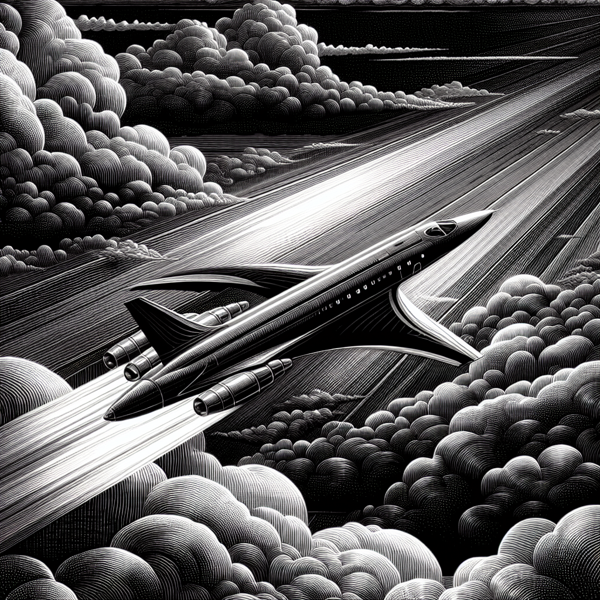
In this episode, Andrew Mayne, Justin Robert Young, and Brian Brushwood dive into a variety of topics starting with Boom’s attempt to bring back supersonic flight, despite the historical and regulatory hurdles. They also touch on the story of a toxic cat in Japan that fell into a vat of chemicals, raising concerns about its whereabouts. The conversation shifts to the rapid advancements in AI, including its use in automating mundane tasks and its potential impact on various industries. The hosts share their excitement and concerns about the future of AI, emphasizing its role as a powerful tool rather than a wish-granting entity. The episode wraps up with discussions on the economic implications of AI and the importance of understanding its capabilities.
Picks:
Brian Brushwood: The Good Place
Justin Robert Young: The Wonderful Story of Henry Sugar
Andrew Mayne: Dune Part Two
Episode Notes
The episode opens with a discussion of Boom Supersonic and its attempt to revive commercial supersonic air travel. The hosts talk about Boom's successful test flight of a scaled-down prototype, the plan for the Overture airliner, the role of Japan Airlines, and the history of Concorde, including sonic booms, U.S. restrictions on supersonic flight, and the Concorde's drooping nose and hot exterior.
A large middle section focuses on AI as practical tooling: how to prompt ChatGPT and vision models more effectively, how OCR and form-filling could save huge amounts of time, and how Andrew's robot demo uses GPT-4 vision to navigate toward butter in a 3D simulation. The discussion expands into agent-style systems such as Cognition Labs' Devon, AI-assisted research and source gathering, productivity gains in editing and transcription, and the idea that AI is best understood as very powerful software rather than a magical wish box.
The final stretch moves through several offbeat stories: a Montana Franken sheep case, a feral hog joke discussion, a toxic cat from a plating factory in Japan, and then a long conversation about Dune: Part Two. On Dune, they debate Paul Atreides' moral ambiguity, Chani's role, prophecy, the Butlerian Jihad, and whether the adaptation captures the complexity and unease of the book.
Key topics
- Commercial supersonic aviation revival: Boom Supersonic is discussed as trying to build a modern supersonic airliner, with a successful prototype test flight, a plan for the Overture, and possible commercial use with Japan Airlines.
- Sonic booms and regulatory limits on supersonic flight: The hosts discuss why sonic booms make overland supersonic flight difficult and how U.S. regulations shaped the market for Concorde and future aircraft.
- Concorde engineering tradeoffs: They mention the Concorde's drooping nose for runway visibility, its advanced systems, and the hot cabin/exterior experience from supersonic speed.
- Prompting large language models: Brian and Andrew talk about prompting as a staged, shared-vocabulary process rather than asking a model for the final answer immediately.
- AI productivity in form-filling and OCR: Andrew argues that AI can drastically reduce time spent on government forms, tax paperwork, OCR, and other repetitive documentation tasks.
- Vision models for spatial reasoning: Andrew's butter-finding robot demo is used to show GPT-4 vision interpreting screenshots and directing movement based on simple instructions and minimal telemetry.
- Agent-based AI and iterative web task execution: They discuss the emerging idea of AI agents that browse, create accounts, do research, and iterate toward completing a task rather than only responding in chat.
- AI-assisted research and source gathering: Andrew describes using ChatGPT to extract source lists from an article draft so he can avoid manually Googling everything.
- AI context recognition and generation quality: The hosts note that AI can now pick up surprising amounts of context, write scenes, and generate art that is convincingly close to the intended subject.
- Automation of podcast and media workflows: They discuss how podcast uploading and similar production workflows could be collapsed into one-button automation.
- AI as practical tooling rather than a magical wish box: The conversation repeatedly frames AI as extremely useful tooling with specific strengths in transcription, copy editing, design understanding, and other concrete tasks.
- Solvable crime and policy through extreme enforcement: Their feral hog and border-crisis jokes explore the notion that some problems can be reduced to aggressive enforcement or radical policy choices, even if that sounds absurd.
- Pet smell, habituation, and cat addiction: The toxic-cat story leads into a side discussion about how people get used to strong pet odors and may not notice how bad a house smells to visitors.
- Dune adaptation, themes, and sequel structure: They go deep on Dune: Part Two, including Paul Atreides' moral ambiguity, Chani's perspective, prophecy, the Butlerian Jihad, the theme of heroism, and how Villeneuve's version compares with earlier adaptations.
Picks
- Brian Brushwood: The Good Place — Explicitly framed as his pick and described as holding up well.
- Justin Robert Young: The Wonderful Story of Henry Sugar — He says he watched it on Netflix, enjoyed it quite a bit, and calls it very fun and really good.